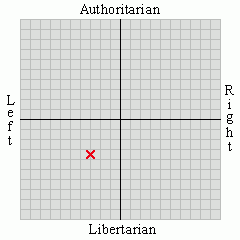
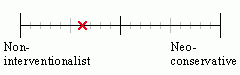
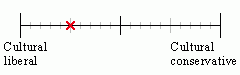
H/T mydavidcameron.com


 [Pic credit: Alan Milligan]
Young Scots Help Gordon SNP Off To Flying Start
Gordon SNP Westminster Candidate, Richard Thomson, was joined in Inverurie this morning by a contingent of young SNP activists, to fire the starting gun on the election race in the constituency following the dissolution of Parliament.
The youth activists, some from as far away as Glasgow and Stornoway, visited the Gordon Constituency as part of a Scotland-wide tour which will see them visit several Westminster seats where the SNP hopes to win at the coming General Election.
Their visit marked the start of the formal campaign as activists began distributing some 40,000 copies of the party’s local newspaper - the ‘Gordon Standard’ – to individuals and households all around the Westminster constituency. Together with local SNP members, some 5,000 copies were delivered around Inverurie in a single morning.Speaking afterwards, Mr Thomson said:
“We’re absolutely delighted to have the support of the Young Scots for Independence today. Their presence reflects the energy and enthusiasm with which we’ve been campaigning over the past few years in the Gordon constituency, as we aim to repeat the success which Alex Salmond had in 2007.
“Our newspaper highlights the many positive achievements of the SNP, both locally and nationally, since the party entered government, and how a strong SNP presence at Westminster can deliver results locally. Our local team already has a strong record of action, and together with an active and engaged SNP MP, we can really begin to deliver results for the North East – particularly if as the pundits expect we end up with a balanced parliament at Westminster.”
Speaking after the day of action, Inverurie resident and YSI National Organiser Jennifer Harkins said:
"I’m delighted to be out campaigning for Richard today, a real local champion for Gordon. He’s running a great campaign here, listening to local residents and doing a lot to champion fair fuel prices for the North East. We’re happy to lend a hand as his campaign gets well underway.
"Activists have gathered from across Scotland to campaign in Inverurie, hitting home our message that it’s only SNP champions like Richard who can protect Scotland from the savage cuts outlined by the Lib-Dems, Labour and the Tories. With more Nats at Westminster like Richard, the SNP can block cuts to Scotland and to the North East."
- Daily communication between the UK and Scottish governments at a ministerial and official level appears to work well. Problems only tend to occur where civil servants in Whitehall are less used to dealing with devolution issues.
- A devolution champion within each UK Government department at senior level should be introduced to maintain higher levels of devolution awareness amongst staff.
- The Committee says it is important that the Secretary of State for Scotland and the Scottish government work together to improve communication where possible.
- Robust debate and discussion between Ministers is healthy and the resumption of Joint Ministerial Committees is to be welcomed. However, greater transparency of proceedings is needed to allow scrutiny of intergovernmental cooperation.
- Opportunities for participation by Scottish Ministers in European Council meetings should be provided by the UK government, where appropriate and where there is agreement on the negotiating line.
- An updated Memorandum of Understanding between the UK and the devolved administrations is long overdue; the 2001 version did not provide adequate guidance on how disputes should be resolved – as demonstrated during communications between the governments on the UK's negotiations with Libya on the Prisoner Transfer Agreement.
- Communications between Whitehall and Scotland at an earlier stage during the negotiations between the UK and Libya could have produced a more satisfactory outcome with a possible carve-out of the prisoner transfer agreement for Mr al-Megrahi. Lessons should be learnt from this.
I watched a very interesting programme on BBC2 this week- Horizon. It took me back to the days when the BBC could be relied upon for quality, informative and entertaining programming.
The subject matter of the Horizon programme was the cosmos and the observations by cosmologists that our universe seemed to defy the accepted laws of physics.
To paraphrase; heavenly bodies appeared to behave in a fashion that was at odds with how they should have been behaving. All scientific theory, mathematical formulae and accepted wisdom predicted that objects were orbiting at speeds that should have resulted in them being thrown about like the contents of a food mixer spinning without the lid. Also, the universe was expanding at ever increasing speed when in fact the gravitational pull of its constituent components should have now arrested this acceleration.
So, what was holding the universe together?
Well, the scientists had a theory for this, that there must be some kind of force influencing the universe that we can neither see nor detect. This strange phenomenon was termed 'Dark Matter'.
‘Dark Matter’! eureka I thought. For this theory offered an explanation as to how Labour in Scotland have managed to escape the Purcell affair pretty much unscathed. The world of Scottish politics must contain an equivalent force, a force that can lessen the effects of otherwise devastating revelations, gaffes and scandals – I have termed this hitherto unknown force 'Disnae Matter'.

After the Crash - re-inventing the the left in Britain
Edited by Richard S.
Grayson and Jonathan Rutherford
© Soundings 2010
We believe that now is the time for a new coalition of ideas and action on the centre left, working together to find common ground for change. At the heart of such a coalition is the belief that social democrats, liberals, greens and civic nationalists share a wide range of concerns. We all want to build a society in which individuals have more life chances, and we all fear for the future of the planet. We all believe that a more equal society is absolutely essential to secure these aims, and we all believe that greater democracy is crucial in giving people power, voice and the ability to secure more freedom and a sustainability economy.
Although Labour remains a central part of the progressive future, there are also tens of thousands of members of the Green Party, Liberal Democrats, Plaid Cymru and the SNP, along with progressive people in no party, who are prepared to discuss this kind of coalition politics. After the Crash is intended to help begin a conversation between these constituencies, so that we can find better solutions to the problems we face than are currently on offer from the mainstream of the major political parties.
Jointly published by Soundings, Social Liberal Forum and Compass, in association with the Media Department at Middlesex University and Department of Politics,
Goldsmiths, University of London. Supported by the Lipman Miliband Trust.
Contributors: Jon Cruddas, Caroline Lucas, Steve Webb, Neal Lawson, Stuart Hall, Doreen Massey, Richard S. Grayson, Jonathan Rutherford, Alan Finlayson, Jonathon Porritt, Leanne Wood, Richard Thomson, Stuart White.
Scottish Liberal Democrat leader Tavish Scott was told by security staff to leave the grounds of an Aberdeen shopping centre yesterday.
Mr Scott visited the city to lend his support to the party’s Fair Deal for Aberdeen campaign, which aims to secure additional government funding for the local authority.
Less than 20 minutes after arriving outside the Union Square shopping centre in Guild Street, the Lib Dem leader was, however, asked to stop canvassing members of the public.